
Understanding what mothers go through
What is perinatal mental health and why does it matter to you?
What is it? Perinatal mental health is about how a woman feels emotionally during pregnancy and in the year after her baby is born. Her body goes through big changes. Her life changes too. Sometimes this is hard — even when the baby is healthy and wanted.
What can go wrong? Some mothers feel very sad, worried, or empty after birth. They may cry a lot, feel alone, or struggle to care for their baby. This is not weakness. It is not her fault. It is something that can happen to any mother.
Why does it matter to you? A mother does not recover alone. She recovers with the people around her. You — as a family member, friend, or neighbour — are one of the most important people in her life right now.
When a mother feels supported, she is more likely to recover. When she feels alone or judged, things can get worse.
What can you do? You do not need to be a doctor to help. Small things matter:
– Sit with her
– Help with the baby or household tasks
– Listen without judgement
– Notice if something seems wrong and encourage her to seek help
Remember: A healthy mother means a healthy baby. Supporting her is supporting the whole family.
A short video on identifying postpartum mental health struggles in new mothers
Noticing they may need support
Lorem ipsum dolor sit amet, at mei dolore tritani repudiandae. In his nemore temporibus consequuntur, vim ad prima vivendum consetetur. Viderer feugiat at pro, mea aperiam
A short video outlining comprehensive support strategies for managing mental health during the perinatal period
How to support them
Lorem ipsum dolor sit amet, at mei dolore tritani repudiandae. In his nemore temporibus consequuntur, vim ad prima vivendum consetetur. Viderer feugiat at pro, mea aperiam
A short podcast explaining that supporting a mother’s mental health is a collective responsibility that requires a “village” of both professional care teams and an active, informed community.
A short podcast explaining that maternal mental health is a collective community responsibility, rather than a private struggle or a strictly medical issue.
A short podcast about breaking the silence surrounding perinatal mental health by addressing community stigma and replacing judgment with active, non-judgmental support.
A short podcast where hosts discuss that that culture is not a barrier to maternal mental health care, but rather a vital lens through which mothers experience distress, seek help, and receive support.
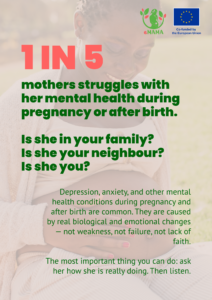
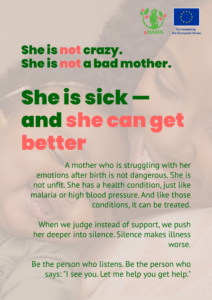
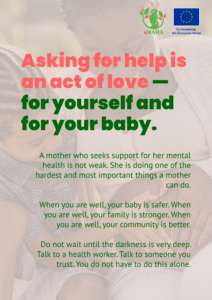
These three posters were developed by the eMAMA project to support community-level awareness about maternal mental health stigma. They are designed to be printed and displayed in places where mothers, families, and community members gather — clinic waiting areas, community health posts, churches, mosques, schools, community centres, and noticeboards. They can also be shared digitally as images on social media, WhatsApp groups, or community platforms. Each poster carries a single, clear message aimed at reducing the shame and silence that prevent mothers from seeking help during pregnancy and after birth. They are intended to start conversations, not end them — so if you display them in a space where you can follow up with discussion, information, or a referral pathway, the impact will be greater. You do not need to be a health professional to use these posters. Anyone who works with or cares about mothers and families in their community can put them up, share them, and use them as a starting point for talking about something that affects far more families than most people realise.