
Fundamentals
A short video about the evolution of perinatal mental health as a field
Welcome to this session on Common Perinatal Mental Health Disorders. The perinatal period, which spans from the start of pregnancy through the first year postpartum, is a critical time for the physical and mental health of parents. While this era of life is often associated with joy and excitement, it can also bring significant emotional and psychological challenges.
In this episode, we will explore the mental health disorders that affect approximately 1 in 5 individuals during pregnancy or the postpartum period. We will move through the spectrum of these conditions, beginning with the very common “baby blues”—a transient mood disturbance affecting up to 80% of new mothers—to more persistent and severe conditions. Our discussion will cover perinatal anxiety, post-traumatic stress disorder (PTSD) related to childbirth, perinatal obsessive-compulsive disorder (OCD), and postpartum depression. We will also address the rare but critical psychiatric emergency known as postpartum psychosis.
By understanding the symptoms, risk factors, and diagnostic criteria of these disorders, healthcare professionals and support systems can better identify and manage the complexities of perinatal health. Ultimately, our goal is to highlight the importance of early intervention and compassionate care to ensure healthier outcomes for parents, infants, and their communities. Let’s begin our exploration of these common, yet often misunderstood, mental health challenges.
Risk Factors for Perinatal Mental Health
What every health professional should know
1. Previous Mental Health History Women with a history of depression, anxiety, bipolar disorder, or psychosis are significantly more likely to experience mental health challenges during pregnancy and after birth. Family history matters too. Most relevant: Before and during pregnancy
2. Lack of Social Support Women who feel alone — without a supportive partner, family, or community around them — are at higher risk throughout the entire perinatal period. Isolation makes everything harder. Most relevant: Throughout
3. Intimate Partner Violence Current or past violence from a partner significantly increases the risk of anxiety, depression, and PTSD. It is often not disclosed and requires a safe environment to identify. Most relevant: During pregnancy and after birth
4. Traumatic Birth Experience Feeling out of control, uninformed, or disrespected during labour — or experiencing emergency interventions — can have lasting psychological effects, including PTSD and difficulty bonding. Most relevant: After birth
5. Sleep Deprivation Severe and sustained sleep loss disrupts emotional regulation and amplifies all other risk factors. It is one of the earliest and most consistent warning signs of deteriorating mental health. Most relevant: First weeks and months after birth
6. History of Trauma or Abuse Adverse childhood experiences or past abuse can resurface powerfully during pregnancy and childbirth. Women may not connect their current distress to past experiences. Most relevant: During pregnancy and birth
7. Poverty and Food Insecurity Financial stress, housing instability, and lack of access to healthcare create chronic pressure that depletes a woman’s capacity to cope. Limited resources also reduce access to support and treatment. Most relevant: Throughout
8. HIV Status and Stigma Women living with HIV face a two to three times higher risk of postpartum depression. Stigma, fear of transmission, breastfeeding pressure, and family blame create compounding psychological stress. Most relevant: Throughout, with particular weight after birth
Remember Risk factors rarely appear alone. The more a woman is carrying, the greater her vulnerability. Awareness is the first step toward support.
Welcome to our discussion on Perinatal Mental Health Intervention Options. In this session, we provide an essential overview of current evidence-based approaches to treating Perinatal Mental Health Disorders (PMH-Ds) across the entire journey—from preconception through the postnatal period. We will explore the critical balance of risk-benefit profiles for various treatments, including psychosocial therapies like Cognitive Behavioral Therapy and pharmacological management.
A central theme of our conversation is the importance of individualized, integrated care and the vital role of a multidisciplinary approach involving obstetricians, midwives, and mental health specialists. Whether we are discussing the nuances of medication safety during pregnancy or the power of community-based support groups, our goal is to understand how to provide safe, effective, and compassionate care for women and their families. Let’s dive into the strategies that foster resilience and promote well-being during this transformative stage of life
Screening and interventions
Mental health disorders during pregnancy and the postpartum period are frequently underdiagnosed within primary healthcare systems, often due to limited awareness, stigma, and inadequate screening mechanisms. Early detection through systematic screening is critical for prompt intervention and improved maternal and neonatal health outcomes. Effective screening and assessment are crucial for identifying perinatal mental health problems early. Several validated tools are available to assist healthcare professionals in this process. The Edinburgh Postnatal Depression Scale (EPDS) is a widely used self-report questionnaire designed to screen for symptoms of depression during pregnancy and the postpartum period. It is a brief and easy-to-administer tool that can be integrated into routine prenatal and postnatal care.
Screening tools serve as an evidence-based approach to systematically identify perinatal mental health disorders (MHD), enabling timely interventions and targeted care strategies.
Why Routine Screening is Essential:
Perinatal mental health disorders, particularly depression and anxiety, significantly impact maternal well-being and child development.
Many women with symptoms of depression and anxiety do not actively seek help, necessitating proactive screening efforts.
There is strong empirical evidence that routine screening reduces perinatal depression and anxiety by facilitating early detection, appropriate referrals, and timely intervention strategies (Gyimah et al., 2024).
There is strong evidence that routine screening for perinatal mental health problems reduces perinatal depression and anxiety.
Tools
Several evidence-based instruments are commonly employed to screen for perinatal mental health disorders. The four most widely used tools include:
The EPDS is a validated, 10-item self-reported screening instrument that effectively identifies perinatal depression symptoms. Its psychometric properties have been extensively studied, confirming its reliability and validity across diverse populations.
Use the link to access the EPDS tool
How EPDS is used
Usually pencil and paper test.
Free to use, copyright with Royal College of Psychiatrists, requires original translated and validated version.
Women should fill the form on their own in the presence of a healthcare professional.
If there is literacy problems, the questions may be verbally presented, explained and simplified to the woman or translated into vernacular language.
When to use EPDS
Recommendation 4-6 weeks postpartum. It can also be used at any point during postpartum.
Scale should be explained to women before completing EPDS in order to gain consent.
Ideally a health worker who is familiar to the woman should administer the tool. Screening when the moment is conducive for the women, when there is privacy and time and no interference (for example family member).
Presenting EPDS
EPDS can be introduced as a conversation about how women are coping with the baby, family and everyday routines. Information about that many women might feel the early parenthood is sometimes challenging and some women might need some support in this period.
That the EPDS is routinely used in clinical settings to address these needs
Be aware that for many depression is attached with stigma and misconception about treatment methods.
Examples for presenting screening tool:
“I routinely ask all women some questions about how they have been feeling since the birth of their baby. I prefer to do this using this EPDS screening scale. Would you mind reading the instructions and filling it out? Then we can talk about it. ”
Interpretation of EPDS
Each 10 statements are scored from 0 – 3 ; with 0 indicating no change from normal and 3 most change from normal functioning.
Some statements are reverse scored. Scores should not be seen in the copy that the woman is filling. Maximum score from 10 items is 30. Cutoff line is usually set to 13 and means positive screen and indicates that the follow up assessment is required. Scores 10 – 12 need a follow-up on 2 – 4 weeks.
Results
EPDS screening tool has been estimated to detect 50-60% of women with perinatal depression. EPDS will produce both false positive and negative results
Low score in EPDS does not always mean that a woman is not depressed or the other way round. Always follow your own clinical judgment and discuss the results with the woman.
Usually, common result with EPDS is between 3 and 8 points.
Examples to response for positive screening results:
Thanks for completing the EPDS scale which is quite sensitive and can pick up lots of different things including symptoms of depression, anxiety and other distress.”
“Looking at your responses, you have indicated that you have been feeling … (discuss her responses). ”
“What do you think is influencing your responses on the scale just now?” (Use clinical judgment to decide whether to monitor and re-administer or refer.)
“What do you think you would like to do about how you are feeling and coping?”
Summary
Score of 13 generally indicates depression but there is other mental health disorders to consider like anxiety, bipolar disorder etc.
Other life events like stress or grief can result higher score without the woman being depressed.
Some physical conditions like anaemia or hypothyroidism can have similar symptoms to depression.
The Patient Health Questionnaire-9 (PHQ-9) is another commonly used screening tool for detecting depression. While not specifically designed for perinatal populations, it can be effectively used to assess depressive symptoms in pregnant and postpartum women. Similarly, the Generalized Anxiety Disorder 7-item (GAD-7) scale is a reliable and valid tool for screening anxiety symptoms in this population.
Access PHQ-9 here: https://novopsych.com/assessments/depression/patient-health-questionnaire-depression-phq-9/#:~:text=The%20PHQ%2D9%20is%20a,activities%20and%20require%20immediate%20attention.
Key Features and Benefits
Brief and Self-Administered:
The PHQ-9 is a short, self-report questionnaire that can be completed by patients in a few minutes.
Diagnostic and Severity Measurement:
It can be used to diagnose major depressive disorder (MDD) and to assess the severity of depressive symptoms.
Dual-Purpose:
The same nine items can establish a depressive disorder diagnosis and grade symptom severity.
Clinical Utility:
It’s useful in clinical practice for treatment planning and monitoring changes in symptoms.
Screening:
In non-clinical settings, it can identify individuals who may need further evaluation for depression.
Age Appropriateness:
Suitable for individuals aged 13 and older.
Scoring:
Responses are scored from 0 to 3, with higher scores indicating more severe symptoms.
Cut-off Scores:
Various cut-off scores are used to categorize depression severity, such as no/minimal, mild, moderate, moderate-severe, and severe depression.
Suicide Ideation Screening:
Question 9 on the PHQ-9 screens for the presence and duration of suicidal thoughts.
How it Works
1. Patient Completes Questionnaire:
The patient answers the nine questions about their experience with depressive symptoms over the past two weeks.
2. Scoring:
Each response is assigned a numerical value (0-3), and these values are summed to create a total score.
3. Interpretation:
The total score is then interpreted to determine the severity of depression.
4. Clinical Assessment:
While the PHQ-9 is a valuable tool, it’s important to remember that a definitive diagnosis should be made by a trained clinician, taking into account other relevant information from the patient.
What is the GAD-7 scale and why is it important in perinatal mental health?
The GAD-7 (Generalized Anxiety Disorder-7) scale is a pivotal, seven-item questionnaire used to assess anxiety levels, particularly among pregnant and postpartum women. Its importance stems from its brevity, simplicity, and reliability in identifying generalized anxiety disorder (GAD) during the perinatal period. This tool is crucial for early detection and timely interventions, which are vital for both maternal and fetal health outcomes, especially given the increased mental health challenges in this population, exacerbated by factors like the COVID-19 pandemic.
How does the GAD-7 scale work and how are its results interpreted?
The GAD-7 scale consists of seven items, each rated on a Likert-scale basis from 0 (not at all) to 3 (nearly every day), based on the individual’s experiences over the previous two weeks. The total score ranges from 0 to 21. Scores are interpreted as follows: 0-4 indicates minimal anxiety, 5-9 indicates mild anxiety, 10-14 indicates moderate anxiety, and 15 or more suggests severe anxiety. These thresholds help healthcare providers determine the urgency and type of interventions needed.
What are the key psychometric properties of the GAD-7?
The GAD-7 has demonstrated robust validity and reliability across diverse populations, including pregnant and postpartum women and various cultural backgrounds. Research has confirmed that both in-person and online versions of the GAD-7 maintain these strong psychometric properties, making it suitable for various healthcare settings, including telemedicine. This reliability ensures that the tool effectively identifies anxiety symptoms indicative of GAD.
What are the prevalence rates of perinatal anxiety and what factors contribute to it?
The incidence of anxiety disorders during the perinatal phase ranges from 8.5% to 10.5%, with alarmingly high postpartum rates. Several factors contribute to this, including socioeconomic status, educational background, previous mental health issues, and external circumstances such as fears related to healthcare access during crises like the COVID-19 pandemic. These findings emphasize the need for a holistic approach to perinatal mental health.
What are the benefits of using the GAD-7 in clinical practice?
One notable advantage of the GAD-7 in perinatal care is its brevity, which makes it feasible for broad implementation in busy clinical settings without significantly increasing patient burden. Its adaptability to online formats also makes it favorable for remote mental health screening, allowing for continuous monitoring and promoting treatment adherence. The GAD-7 also helps identify social determinants exacerbating anxiety, promoting comprehensive support tailored to individual needs.
What are the limitations or drawbacks of the GAD-7?
Despite its strengths, the GAD-7 has limitations. One concern is the possibility of false positives, where individuals may score high without a formal GAD diagnosis. Additionally, perinatal anxiety can manifest differently than in a non-perinatal population, potentially complicating score interpretation. The GAD-7 also doesn’t encompass the broad spectrum of perinatal mental health issues or capture all nuances of anxiety symptoms, potentially underestimating the severity or complexity of a woman’s mental health condition. Its reliance on self-reported data can also lead to variations influenced by emotional state, situational factors, or cultural stigma.
How can the limitations of the GAD-7 be mitigated in clinical practice?
To mitigate its limitations, clinicians are encouraged to complement the GAD-7 with comprehensive clinical assessments and additional screening tools for other mental health aspects, such as the Edinburgh Postnatal Depression Scale (EPDS) for mood disorders. Integrating GAD-7 results with qualitative insights (through interviews or open-ended questions) can also enhance understanding. Effective implementation requires combining the tool with systems for timely follow-ups and referrals, and fostering collaborative practice among obstetricians, midwives, mental health specialists, and social workers.
How does the GAD-7 contribute to a supportive healthcare environment for perinatal women?
The GAD-7 contributes to a more supportive healthcare environment by enabling routine screening for anxiety, which helps destigmatize seeking help among mothers. Interventions based on GAD-7 findings show increased efficacy when paired with targeted psychological support strategies, educational seminars for healthcare professionals, and multidisciplinary approaches. This comprehensive integration of mental health screening into routine care promotes better understanding and management of anxiety disorders, ultimately supporting improved health outcomes for mothers and their infants.
The Whooley questions serve as a streamlined screening tool designed to detect depression and anxiety in women during the perinatal period. Consisting of only two inquiries regarding mood and interest, this method is valued for its brevity and clinical efficiency compared to longer diagnostic assessments. While healthcare providers appreciate how the tool normalizes mental health discussions, its success is often hindered by a lack of professional training and insufficient follow-up resources. Critics also highlight the need for greater cultural sensitivity and systemic reforms to ensure that diverse populations receive equitable care. Ultimately, while these questions are effective for early identification, they must be supported by a comprehensive care pathway to truly improve maternal health outcomes.
A negative test essentially rules out major depressive disorder (95% sensitivity).
A positive test identifies patients who may benefit from further evaluation (65% specificity).
The Whooley Questions are in the public domain and may be used without permission.
Access here: https://whooleyquestions.ucsf.edu/
2
areas central to effective perinatal mental health care: developing your own reflective practice, and working collaboratively across disciplines to support mothers and families.
Reflective practice is more than a learning technique — it is a clinical skill. In perinatal mental health, where emotional, cultural, and relational dynamics shape every encounter, practitioners who reflect on their work tend to provide safer, more attuned, and more sustainable care. The resources below introduce the theoretical foundations of reflective practice and offer practical ways to embed it in everyday clinical work.
A podcast on reflective practice in clinical settings
Perinatal mental health rarely sits within a single discipline. Effective care depends on coordinated input across midwifery, primary care, mental health, and community services — and on the practitioner’s ability to guide and counsel mothers through complex decisions about their own care. The resources below cover collaborative care models, individualised care planning, and guidance and counselling approaches for perinatal mental health.
A podcast on collaborative care models
A podcast on individualied care planning
A podcast on guidance and counselling approaches for perinatal mental health
Families and community in care
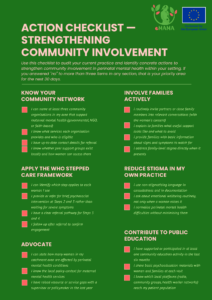
Effective perinatal mental health care extends beyond the consultation room. Engaging community structures — families, faith groups, local organisations, peer networks — strengthens detection, reduces barriers to disclosure, and supports recovery. The resources below introduce community involvement as a clinical competency and offer a practical tool to audit your own practice.
Stigma is one of the most consistent barriers to perinatal mental health care — shaping who discloses, who seeks help, and who recovers. These two short videos examine how stigma operates in clinical encounters and outline a practical three-step approach to addressing it.
A short video about stigma in clinical encounters
A short video about 3-step approach on addressing stigma
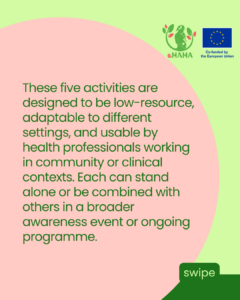
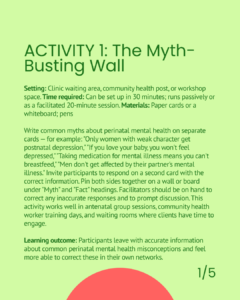
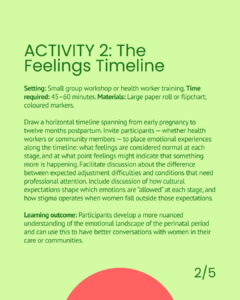
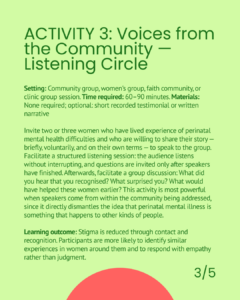
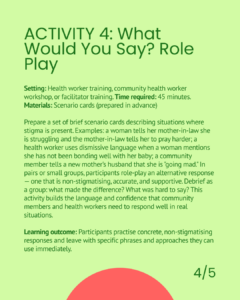
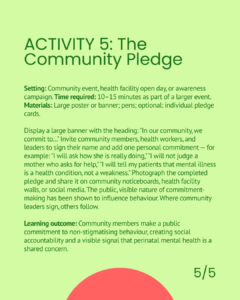
Five low-resource awareness activities for use in clinical settings, training, or community engagement. Each can stand alone or be combined with others as part of a broader campaign. Adapt the timing, materials, and language to fit your setting.
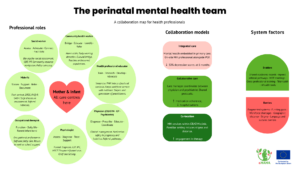
Perinatal mental health care depends on coordinated input across disciplines — midwifery, primary care, mental health, social work, occupational therapy, and community health. Knowing who does what, and how the roles connect, strengthens referral pathways and reduces gaps in care. The video and collaboration map below set out the roles, the models that bring them together, and the system factors that enable or hinder integration.
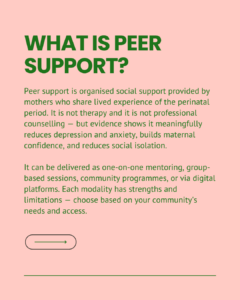
Peer support — organised social support from mothers with lived experience of the perinatal period — is increasingly recognised as a complement to clinical care, with evidence for reducing depressive symptoms, building maternal confidence, and lowering social isolation. The video below introduces a practical model for postpartum peer support.
A short video on a practical model for postpartum peer support
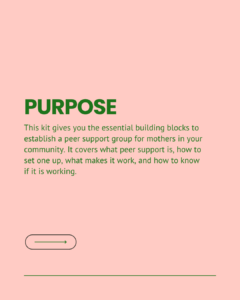
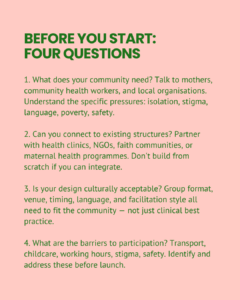
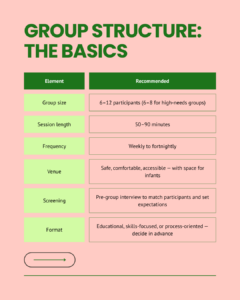
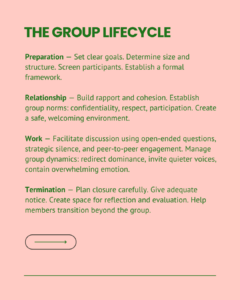
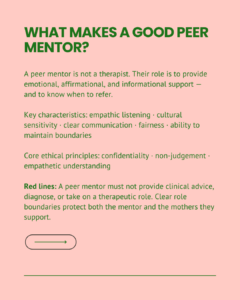
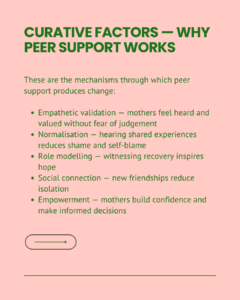
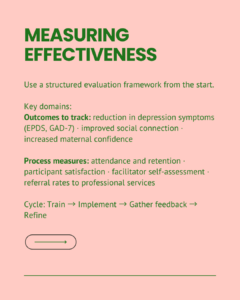
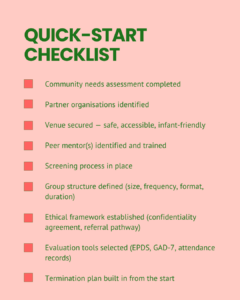
A ten-slide implementation kit for setting up a peer support group in your community. Covers what peer support is and is not, how to assess readiness, how to structure a group, what makes a good peer mentor, why peer support works, and how to evaluate effectiveness. Use it as a planning document or share it with partner organisations.
Culture shapes how distress is expressed, understood, and treated — and how mothers experience the clinical encounter itself. Cultural sensitivity is not an add-on to good practice; it is part of it. The video below makes the case for treating cultural competence as a clinical skill rather than a soft skill.
A short video on cultural sensitivity and competence
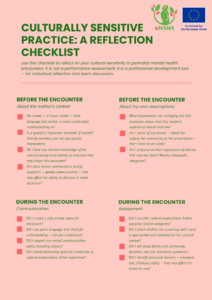
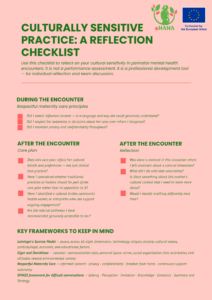
A two-page reflection checklist for use before, during, and after clinical encounters. Framed as a professional development tool rather than a performance assessment, it surfaces assumptions, biases, and structural barriers, and points to four established frameworks for further reading. Use it individually or as a basis for team discussion.